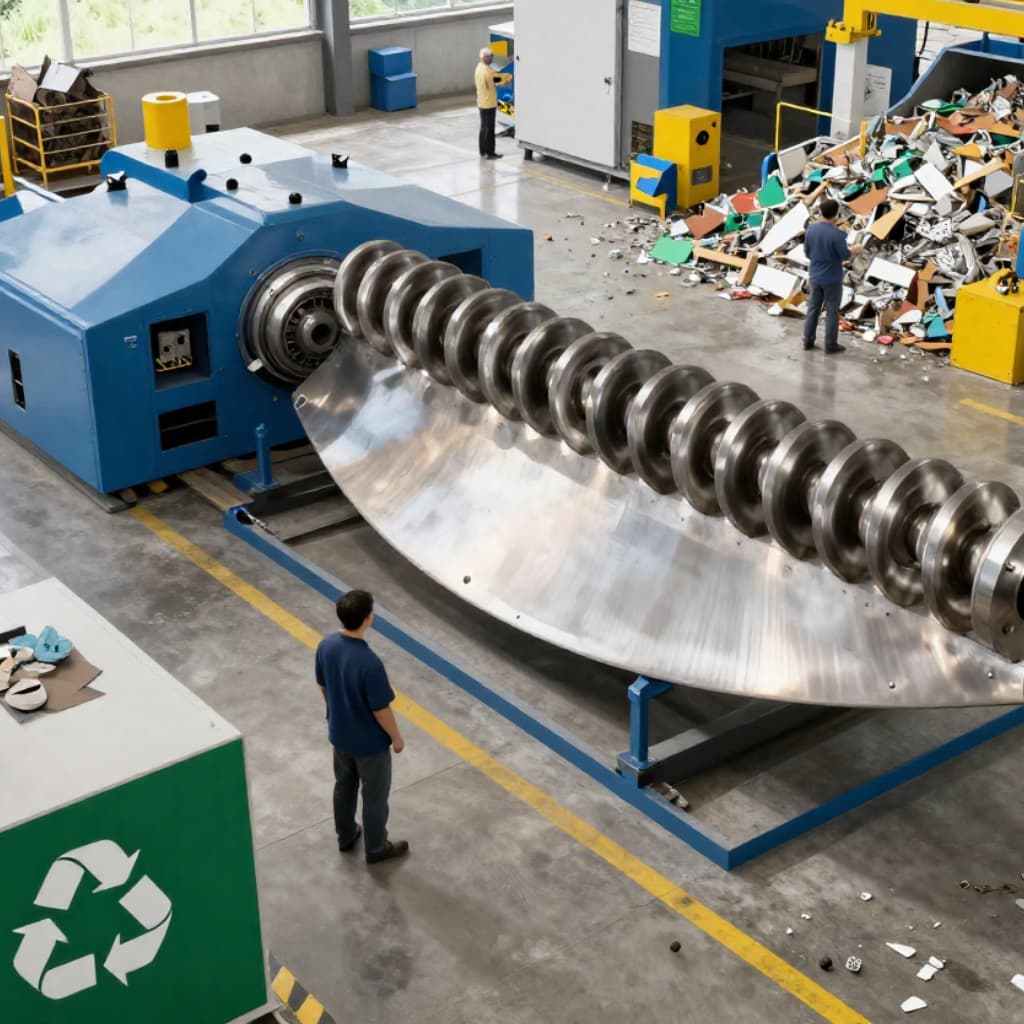

In recycling facilities, production continuity largely depends on the quality of the blades and liners used. Equipment working in shredding, cutting, and grinding systems operates under irregular loads, sudden impacts, and abrasive contact. Therefore, the right blade selection is not just a spare part choice but a critical decision that directly affects production efficiency.
An incorrectly selected blade:
-
Reduces cutting performance
-
Increases energy consumption
-
Raises the motor and shaft load
-
Increases the frequency of part replacement
Similarly, the use of unsuitable liners causes damage to the machine body and increases maintenance costs.
Therefore, the goal in recycling lines is not just to use a "hard" material; it is to choose the right quality that offers a balance of wear resistance and impact resistance. A properly planned blade and liner combination both extends equipment life and lowers the production cost per ton.
Why Is Wear More Complex in Recycling?
Recycling facilities do not work with a single type of material. Within the same system, there can be metal, plastic, glass, concrete, and even unexpected hard parts. This creates both abrasive and impact loads on the equipment.
Especially in crushing and shredding systems:
-
High friction
-
Sudden impact
-
Sharp edge contact
-
Variable density
are seen together. Therefore, blade and liner selection is not an ordinary steel choice; it is a strategic decision that directly affects system performance.
Technical Criteria to Consider in Blade Selection
Recycling blades take on the task of cutting, shredding, and grinding. Wrong blade selection:
-
Reduces cutting performance
-
Increases energy consumption
-
Raises the motor load
-
Increases the frequency of part replacement
Things to evaluate for the right selection:
-
Material type (metal, plastic, cable, construction waste)
-
Cutting geometry
-
Hardness level
-
Surface durability
-
Heat treatment quality
No matter how hard the blade is, if there is not enough toughness, the risk of breakage increases. Therefore, not just hardness but also impact resistance is important.
Liner Selection: Surface Protection Strategy
Liners act as armor that protects the body from wear. Especially rotor chambers, side walls, and material flow surfaces are subject to intense friction.
Thanks to the right liner selection:
-
Body damage is prevented
-
Welded areas are protected
-
A replaceable surface system is created
Modularly designed liners allow only the worn part to be replaced without dismantling the entire machine.
The Effect of Wrong Material Selection on Production
A low-cost part may seem attractive at first. However, in a short time:
-
Cutting quality decreases
-
Vibration increases
-
Unbalanced wear occurs
-
Unplanned stoppages occur
This reduces production efficiency and increases operating costs.
What really matters in recycling facilities is not the part price, but the production cost per ton.
Why Is the Hardness–Toughness Balance Critical?
The impacts encountered in recycling machines are not homogeneous. A hard metal part can apply a sudden impact to the blade.
If the material:
-
Is very hard but brittle → it cracks
-
Is very tough but soft → it wears quickly
Therefore, the ideal solution is a steel quality that offers a balance of wear resistance and impact resistance.
Different Requirements for Metal, Plastic, and Construction Waste
Not every recycling line is the same.
-
In plastic recycling, sharpness and surface smoothness are important.
-
In metal scrap, impact resistance comes to the forefront.
-
In construction waste, the abrasive mineral content is high.
These differences require the blade and liner quality to be determined specifically.
The Right Design That Extends the Maintenance Period
Correct assembly and design are as important as the right material.
-
Replaceable modular systems
-
Easily removable connections
-
Extra reinforcement at critical points
shorten maintenance time and reduce downtime cost.
The Right Part Selection in Total Cost Calculation
For sustainable production in recycling facilities:
-
Longer part life
-
Less downtime
-
Lower energy consumption
-
More stable cutting performance
should be targeted.
The right blade and liner selection optimizes not just the equipment but the entire operation.

 EN
EN  TR
TR