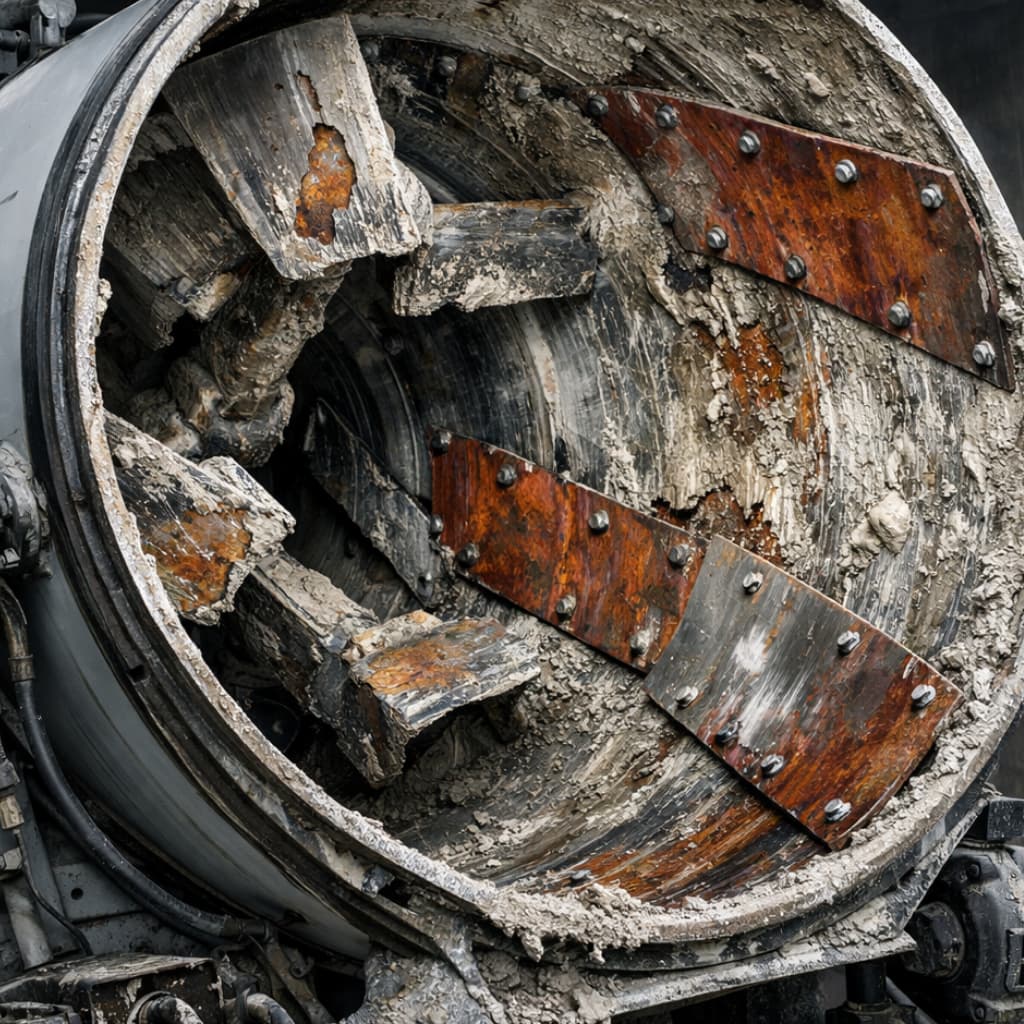

Concrete plants and mixer systems work under constant friction and intense mineral contact. The mixture of aggregate, cement, and water creates a serious abrasive effect, especially on the inner surfaces of the drum and on the mixer blades. Therefore, when the right material selection is not made, equipment life is much shorter than expected.
Wear is not just surface thinning. It also means:
-
Capacity decrease
-
Increase in energy consumption
-
Unbalanced mixture
-
Unplanned stoppages
means.
Why Does Wear Occur in Concrete Mixers?
The aggregate used in concrete production is a hard, sharp material with a strong mineral structure. It moves inside the drum in a continuous cycle and contacts the surfaces.
The main causes of wear:
-
The friction effect of hard aggregate
-
High rpm inside the drum
-
Insufficient surface protection
-
Wrong material quality
Especially in dry and high-capacity production, the wear rate increases.
Critical Wear Areas
Not every area wears the same way in concrete mixers. The riskiest areas:
-
The inner surface of the drum
-
The mixer blades
-
Side wall transition areas
-
The material outlet
When the right steel selection is not made in these areas, the body starts to get damaged and the cost multiplies.
Why Is the Right Material Selection Important?
Standard structural steels do not last long in concrete plants. Because special steels with high wear resistance are required for these systems.
The right material:
-
Offers high surface hardness
-
Provides impact resistance
-
Shows a homogeneous structure
-
Maintains its performance after welding
Wrong selection, on the other hand, increases the risk of early deformation and cracking.
Hardness or Toughness?
When selecting a material, focusing only on hardness is not correct. A very hard but brittle material can crack under impact. A very tough but soft material, on the other hand, thins quickly.
Therefore, the ideal solution in concrete mixers is qualities that offer a balance of wear resistance and impact resistance.
Design Approaches That Reduce Wear
Not only the material but also the design is decisive.
-
Replaceable wear plates
-
Modular blade systems
-
Reinforcement plates in critical areas
Thanks to these methods, instead of replacing the entire drum, only the worn parts are renewed.
The Hidden Cost of Wrong Selection
Although low-quality material seems economical in the short term:
-
Frequent part replacement
-
Production loss
-
Labor cost
-
Energy increase
increase the total cost.
What matters in concrete plants is not the part price, but the annual operating cost.
Conclusion
Wear in concrete mixers is inevitable; but it can be controlled with the right material selection. With appropriate hardness, the right quality, and correct application, equipment life is extended, maintenance frequency decreases, and production efficiency increases.
For long-lasting concrete plant equipment, the right wear solutions are critically important for the sustainability of the business.

 EN
EN  TR
TR